Owens-Thomas House & Slave Quarters
The Owens-Thomas House & Slave Quarters represents one of the finest examples of English Regency architecture in America and one of the first historic sites to prioritize comprehensive interpretation of enslaved people's experiences. Designed by architect William Jay and completed in 1819, this National Historic Landmark combines architectural brilliance with groundbreaking social history. The house operated by Telfair Museums offers extraordinary insights into both the privileged lives of white owners and the harsh realities of enslaved African Americans who labored there.
Location
124 Abercorn Street, Savannah, GA 31401
Oglethorpe Square, Historic District
Hours
Monday-Saturday 10 AM - 5 PM, Sunday 1 PM - 5 PM
Guided tours begin every 30 minutes. Last tour 4 PM. Closed major holidays. Ticket includes access to house and slave quarters. Purchase at house or combination ticket with other Telfair Museums.
Pricing
$$ (Moderate)
Adults $20 for Owens-Thomas House only, or $25 for combination ticket including all Telfair Museums. Students and military discounts available. Children 5 and under free.
Best Time to Visit
Time Needed
1.5-2 hours for comprehensive tour of house and slave quarters
Discover More Things to Do in Savannah
Find the best dining, attractions, entertainment, and experiences across Savannah. Create your perfect itinerary and discover why the Hostess City captivates every visitor.
The Owens-Thomas House: Architectural Masterpiece
The Owens-Thomas House stands as the finest example of English Regency architecture in the United States and one of the most significant early 19th-century buildings in America. Designed by brilliant young English architect William Jay and completed in 1819 for cotton merchant Richard Richardson, the house showcases innovative architectural features, exquisite proportions, and sophisticated design that influenced American architecture. Designated a National Historic Landmark, the house demonstrates remarkable architectural integrity and serves as textbook example of Regency style adapted to American Southern climate and culture.
William Jay: Visionary British Architect
William Jay (1792-1837) arrived in Savannah in 1817 at age 24 and revolutionized the city's architecture during his brief tenure. The English-trained architect introduced sophisticated Regency style to the young republic, designing multiple Savannah landmarks including Telfair Academy and Scarborough House. Jay's genius lay in adapting English architectural principles to American conditions, incorporating innovative features like indoor plumbing, advanced climate control, and space-efficient design. His work elevated Savannah's architectural standards and influenced Southern architecture for decades. After returning to England in 1824, Jay's American legacy endured through his exceptional buildings.
Revolutionary Architectural Features
The Owens-Thomas House incorporates remarkably advanced features for 1819:
- Indoor Plumbing: One of America's earliest examples of indoor running water and toilets (1820s)
- Central Ventilation: Innovative air circulation system for cooling in Southern heat
- Natural Lighting: Clerestory windows and skylights maximizing daylight throughout interior
- Space Efficiency: Brilliant use of compact urban lot with bridge connecting to carriage house
- Classical Proportions: Perfect mathematical relationships creating harmonious spaces
- Curved Walls: Elegant curved drawing room and oval entry demonstrating sophisticated construction
- Ornamental Details: Plasterwork, marble, and decorative elements of exceptional quality
The House Tour Experience
Guided tours reveal the house's architectural brilliance and social complexity:
- Entry Hall: Oval vestibule with elegant staircase and sophisticated spatial design
- Drawing Room: Magnificent curved room with original furnishings and decorative arts
- Dining Room: Formal space showcasing period furniture and dining customs
- Family Bedrooms: Private quarters revealing domestic life of wealthy white family
- Service Spaces: Behind-the-scenes areas showing household operation
- Historic Furnishings: Period-appropriate furniture, artwork, and decorative objects
- Architectural Details: Interpretive information highlighting Jay's innovations
The Urban Slave Quarters: Pioneering Interpretation
The Owens-Thomas House Slave Quarters represent one of the earliest intact urban slave dwellings accessible to the public and a landmark in historic interpretation. The separate building connected to the main house via bridge housed enslaved African Americans who performed all household labor. Telfair Museums' groundbreaking interpretation confronts slavery's brutal realities while honoring enslaved people's humanity, resilience, and contributions. This approach represents paradigm shift in American house museums, prioritizing complete historical truth over sanitized narratives.
Stories of Enslaved People
Through archaeological evidence, census records, and contextual research, interpretations illuminate enslaved people's experiences:
- Living Conditions: Cramped quarters with minimal amenities contrasting sharply with owners' luxury
- Labor Requirements: Exhausting daily tasks maintaining household, cooking, cleaning, serving
- Family Separation: Devastating practice of separating enslaved families through sale
- Resistance & Resilience: Ways enslaved people maintained dignity, culture, and hope
- Post-Emancipation: Challenges facing freed people after Civil War
- Individual Names: Effort to identify and honor specific individuals who lived and labored there
The Lafayette Balcony
In 1825, the Marquis de Lafayette addressed Savannah citizens from the house's second-floor balcony during his triumphant American tour. This iron balcony, overlooking Oglethorpe Square, witnessed the Revolutionary War hero's speech to adoring crowds. The event demonstrates the house's role in Savannah's civic life and early American history. Visitors can see the historic balcony and imagine Lafayette acknowledging the crowd's enthusiasm.
English Regency Style in America
The house exemplifies English Regency architectural characteristics adapted to American context:
- Symmetrical Facade: Balanced composition with central entrance and matching windows
- Stucco Finish: Smooth stucco over brick creating refined appearance
- Cast-Iron Details: Delicate ironwork on balconies and railings
- Classical References: Greek and Roman architectural elements
- Elegant Proportions: Mathematical relationships creating visual harmony
- Restrained Ornament: Sophisticated decoration avoiding excess
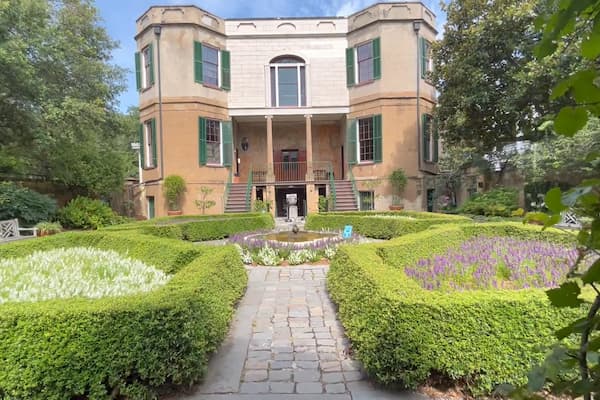
The Historic Parterre Garden
Behind the house lies a meticulously restored parterre garden designed in formal geometric patterns typical of early 19th-century landscape design. The garden provides tranquil green space featuring boxwood hedges, seasonal plantings, brick pathways, and period-appropriate plant selections. Archaeological research guided the restoration, ensuring historical accuracy. The garden represents important aspect of wealthy households where enslaved gardeners maintained ornamental landscapes for owners' pleasure.
Operated by Telfair Museums
The Owens-Thomas House operates as part of Telfair Museums, Georgia's oldest art museum. This connection allows combination tickets covering the Owens-Thomas House, Telfair Academy (Regency mansion art museum), and Jepson Center (contemporary art museum). The three-building museum complex offers comprehensive cultural experience spanning architecture, decorative arts, American and European fine arts, and contemporary creativity. Consider visiting all three for deep dive into Savannah's cultural treasures.
Educational Programs & Interpretation
Telfair Museums emphasizes educational programming at the Owens-Thomas House:
- Guided Tours: Expert interpreters providing architectural and social history context
- School Programs: Curriculum-aligned field trips for students
- Interpretive Panels: Signage throughout slave quarters providing detailed information
- Special Events: Lectures, symposia, and commemorations addressing slavery and its legacy
- Living History: Occasional programs featuring costumed interpretation
- Archaeological Research: Ongoing investigation revealing new insights
National Historic Landmark Status
The Owens-Thomas House earned National Historic Landmark designation recognizing its exceptional national significance in American architecture and history. This highest level of recognition acknowledges both William Jay's architectural genius and the site's importance in understanding American slavery. The designation ensures permanent protection and professional stewardship of this irreplaceable cultural resource.
Confronting Difficult History
The Owens-Thomas House represents pioneering effort in American historic sites to confront slavery honestly and comprehensively. Rather than minimizing or romanticizing slavery, interpretation presents unflinching examination of this institution's brutality while honoring enslaved people's humanity. This approach recognizes that complete historical understanding requires confronting uncomfortable truths. The house serves as model for other historic sites grappling with slavery's complex legacy in American history.
Architectural Preservation
The house's exceptional preservation allows authentic experience of early 19th-century architecture and interiors. Telfair Museums maintains conservation standards ensuring long-term protection while allowing public access. Ongoing research, archaeological investigation, and careful restoration work continuously deepen understanding of the house and its inhabitants—both enslaved and free.
Planning Your Visit
To maximize your Owens-Thomas House experience:
- Allow Adequate Time: Budget 1.5-2 hours for comprehensive tour
- Take Guided Tour: Expert interpretation essential for understanding significance
- Visit Slave Quarters: Don't miss this crucial component of complete story
- Combination Ticket: Consider visiting all three Telfair Museums buildings
- Ask Questions: Guides welcome questions about architecture and history
- Reflect on Complexity: Allow time to process the site's layered, challenging history
- Explore Garden: Beautiful parterre garden provides contemplative space
Broader Cultural Significance
Beyond architectural brilliance, the Owens-Thomas House contributes to vital national conversations about slavery, memory, and historical truth-telling. As American society continues reckoning with slavery's enduring legacy, sites like this provide essential educational resources. By presenting both magnificent architecture and brutal slavery in honest, integrated narrative, the house challenges visitors to embrace historical complexity and recognize how past injustices shaped present realities.
Pairing House Tour with Cultural Evening
The Owens-Thomas House offers profound cultural and educational experience that complements evening theatre beautifully. Tour the house afternoon, allowing time to absorb its architectural beauty and challenging history. Walk through historic district reflecting on what you've learned, enjoy dinner discussing the experience, then attend New Oak Theatre performance. This combination creates meaningful day connecting past and present, architecture and performance, difficult history and contemporary creativity.
Visitor Information
Parking
Street parking on Abercorn and surrounding streets. Parking garages nearby on State Street and York Street. Metered parking available.
Accessibility
- Wheelchair accessible
- Accessible parking available
- Near public transit
Wheelchair accessible via lift entrance. First floor fully accessible. Upper floors accessed by stairs. Slave quarters accessible. Audio tour available. Street parking nearby.
Related Attractions
- Telfair Academy
- Telfair Museums
- Cathedral of St. John the Baptist
- First African Baptist Church
- City Market
- New Oak Theatre